Rethinking Technical Debt: How AI Changed the Way We Maintain Software

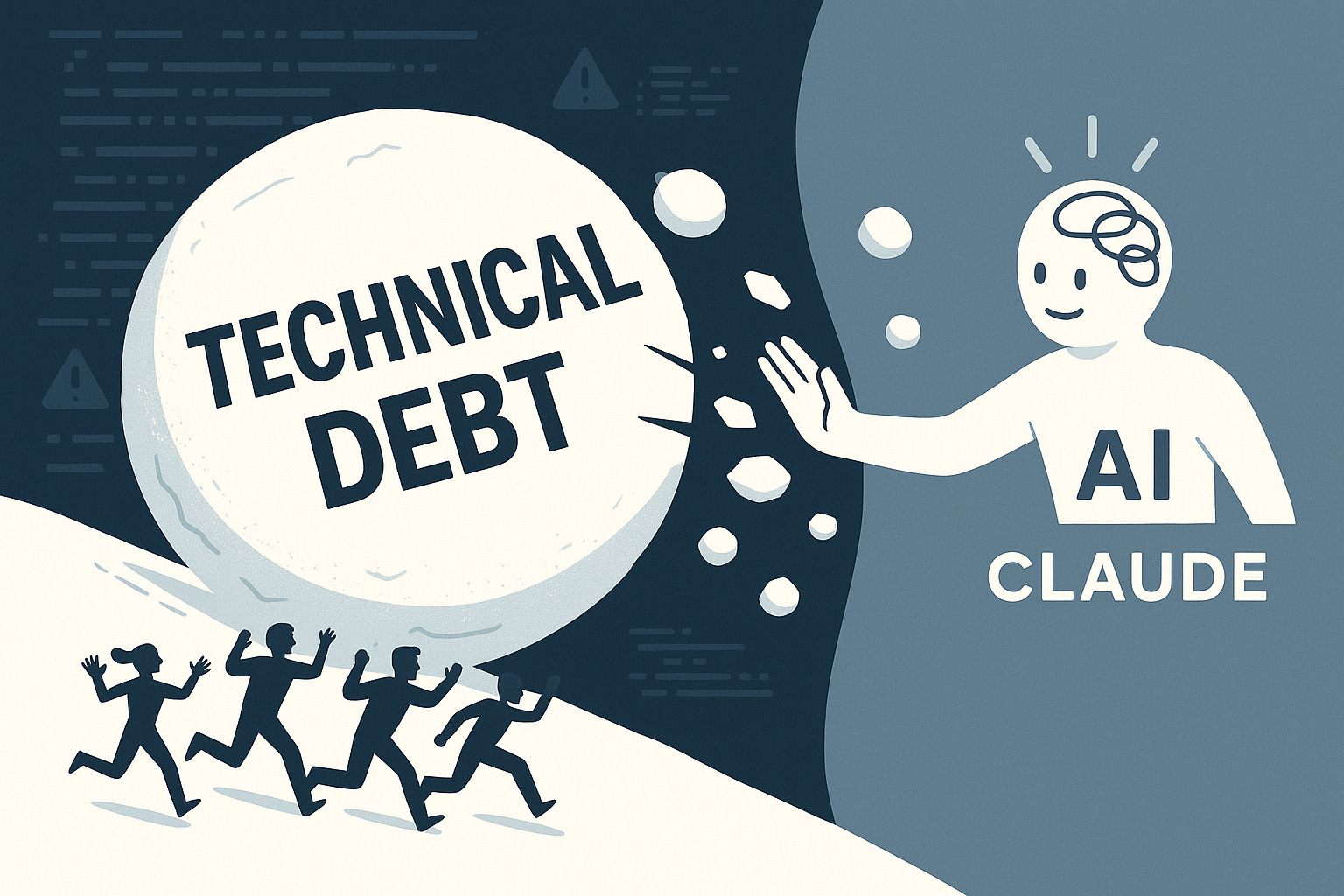
Technical debt behaves exactly like financial debt - ignore it and the interest payments become unsustainable.
I learned this the hard way when our chat system started falling apart. Messages duplicated themselves. Interface elements floated in wrong places. Users lost trust in features that worked "most of the time."
Here's what happened when we stopped building new features and focused entirely on fixing what we had.
The Surprising Economics of AI-Assisted Maintenance
Using Claude Code for maintenance work revealed something counterintuitive: AI tools make fixing existing systems more cost-effective than building new ones.
Where AI excelled beyond expectations:
Traced bugs across 15+ interconnected files systematically
Refactored an 800-line component into focused services safely
Debugged race conditions in real-time streaming that would take days manually
Eliminated 600+ lines of duplicate code without breaking functionality
The game-changing insight: Using /clear frequently prevented the AI from getting stuck in debugging loops. Most developers don't realize context confusion is why AI solutions sometimes feel circular.
Single Agent vs. Multiple Agents: The Productivity Myth
Everyone talks about using multiple AI agents in parallel. After trying both approaches on complex systems, I found the opposite works better.
Why single-threaded AI development won:
Multiple agents need constant coordination on interconnected systems
Context switching between agents actually slows progress
Quality control becomes exponentially harder with parallel work
One focused agent maintains system-wide awareness that multiple agents lose
For 54 commits across two repositories, having one AI agent that understood the full relationship between frontend chat bugs and backend streaming issues proved more effective than trying to parallelize the work.
The Compound Interest Effect of Small UI Problems
We fixed 15 different alignment bugs that seemed minor individually. But they combined to make the entire interface feel broken.
The pattern we discovered:
Avatar positioning issues made users question message authenticity
Inconsistent spacing broke visual hierarchy in conversations
Progress indicators that wouldn't clear created anxiety about system health
Scrolling problems interrupted thought flow during long discussions
Each small problem reduced user confidence incrementally. Together, they created a death-by-a-thousand-cuts user experience.
Real-Time Systems Have Different Rules
Server-Sent Events streaming taught us that real-time features follow different principles than regular web development.
What breaks streaming that doesn't break normal requests:
State management becomes critical - each chunk depends on previous chunks
Race conditions appear in places you don't expect
Memory leaks from "temporary" indicators that never clean up
JSON buffering issues that only show up under real user load
The breakthrough fix was incremental content tracking instead of replacing entire messages. This eliminated duplication and made streaming reliable.
The Business Context (What Actually Happened)
We spent two weeks on pure maintenance work. No new features. No exciting launches. Just fixing what we already built.
The hard numbers:
54 commits over 10 days
Chat initialization improved from 800ms to 100ms
Eliminated duplicate content in streaming
Reduced code duplication by 600+ lines
Fixed 15+ UI alignment and positioning bugs
What we worked on:
Cloud Atlas Insight frontend: 42 commits (78%)
Flow backend: 12 commits (22%)
What We Fixed (The Technical Details)
Chat System Reliability (40% of effort)
Messages showing up twice in conversations
Avatar positioning inside message bubbles
User vs assistant message alignment
Padding and spacing inconsistencies
Chat scrolling viewport problems
Progress indicator styling that wouldn't clear
Streaming Infrastructure (30% of effort)
Server-Sent Events content duplication
Multiple orange bot indicators appearing simultaneously
Race conditions causing artifacts to vanish
Message type handling (thinking, system, result, progress)
JSON buffering for chunked responses
Transient message cleanup
Code Organization (20% of effort)
Created PlanGenerationService (moved 330+ lines from component)
Built reusable SSEStreamEngine (eliminated 400+ duplicate lines)
Applied DRY principles to reduce SSE-related code by 200+ lines
Renamed FlowEngineChat to FlowPlan for clarity
Updated routing from /flow-chat to /flow-plan
Improved semantic naming throughout
Backend Integration (10% of effort)
Fixed Claude CLI execution errors with proper -p flag configuration
Added comprehensive debug logging
Improved git worktree creation reliability
Added Claude API provider with Anthropic Go SDK
Consolidated LLM configuration
Updated Swagger documentation
The ROI That Nobody Talks About
Maintenance work doesn't show up in feature announcements, but the business impact was significant:
Performance gains:
8x faster chat initialization
Eliminated user-reported streaming glitches
Reduced component re-renders
Better JSON parsing efficiency
Development velocity improvements:
Centralized streaming logic eliminates future duplication
Better separation of concerns makes debugging faster
Improved error handling prevents escalation
Better logging reduces troubleshooting time
User experience improvements:
Reliable streaming without duplicate content
Consistent interface behavior
Eliminated confusion from UI bugs
Faster response times
When to Stop Building Features
The decision framework that guided us:
Stop feature development when:
User complaints about reliability increase
Bug reports cluster around specific systems
Development velocity slows due to technical debt
New features become harder to build on unstable foundations
Keep building when:
Market opportunity requires fast feature delivery
Technical debt is isolated and not affecting user experience
Team has bandwidth to address issues incrementally
For us, streaming reliability issues were directly affecting user trust. The maintenance work became necessary to protect our competitive position.
The Real Impact on Competitive Position
Users compare platforms constantly. When core features work reliably, users stay engaged. When they break intermittently, users lose trust and explore alternatives.
The two weeks of maintenance work protected our competitive advantage. A stable platform lets users focus on their work instead of fighting our interface.
Infrastructure problems that seem "minor" to developers feel like platform instability to users. Fixing them isn't glamorous, but it's strategic.
What We Learned About Resource Allocation
Most software development is maintenance, not shipping new features. This sprint reinforced that foundation work isn't a distraction from "real work" - it enables real work.
The business temptation is always to prioritize visible features over invisible stability improvements. But infrastructure problems compound over time and eventually force expensive emergency fixes.
Technical debt management needs to be ongoing, not episodic. When systems start showing strain, address issues before they become user-facing problems.
What's Next
With streaming stable and code organized, we return to feature development from a stronger foundation. But we learned that systematic maintenance combined with AI-assisted development gives us a proven approach for future technical debt.
Building reliable software means accepting that not every sprint ships user-facing features. Sometimes the most valuable work happens behind the scenes, protecting user experience and enabling future development velocity.
The combination of focused AI agents, systematic refactoring, and incremental improvements made this maintenance work more efficient than traditional manual debugging. When technical debt accumulates again, we have a repeatable process to address it cost-effectively.
AI tools don't eliminate technical debt, but they change the economics of addressing it. The key is recognizing when platform stability becomes more valuable than new features.